

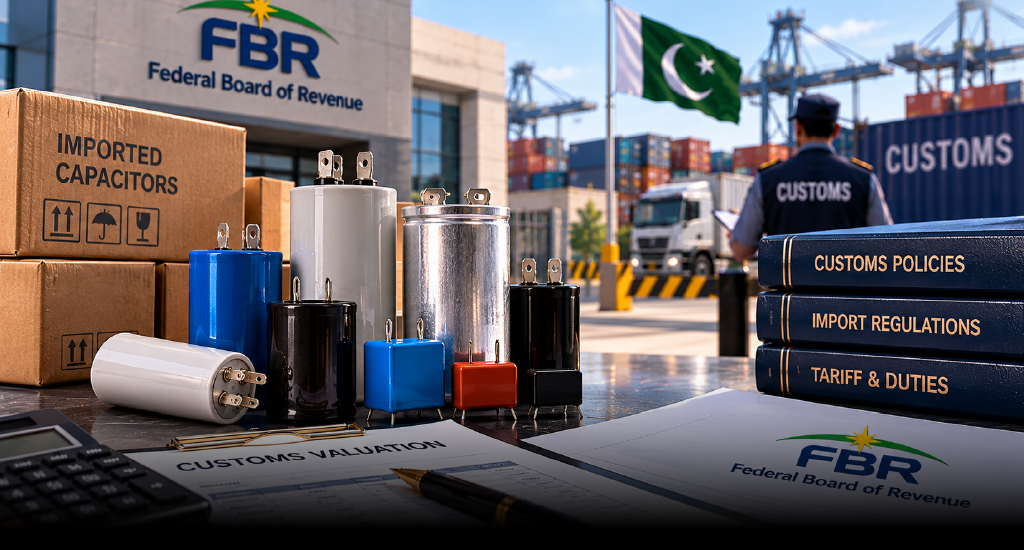
The Federal Board of Revenue (FBR) has announced revised customs values for imported capacitors through Valuation Ruling No. 2120/2026, issued by the Directorate General of Customs Valuation in Karachi on October 22, 2026.
The new ruling replaces the previous valuation framework introduced in 2015. It aims to bring customs assessments closer to prevailing market conditions, improve consistency in import valuation, and support the accurate assessment of customs duties and taxes.
The revised values cover several types of capacitors imported from China, including components used in electric motors, water pumps, refrigeration systems, and domestic appliances.
Why Has the FBR Revised Capacitor Customs Values?
Customs valuation plays an important role in determining the duties and taxes payable on imported goods. When existing valuation benchmarks no longer reflect market prices, authorities may review and update them to improve the accuracy and consistency of customs assessments.
According to the reported ruling, the FBR considered stakeholder consultations conducted in September 2026 and analysed 90 days of import data before establishing the revised values.
The updated framework is intended to address outdated pricing benchmarks and provide customs authorities with a consistent basis for assessing the specified imported capacitors.
Revised Customs Values of Imported Capacitors
Under Valuation Ruling No. 2120/2026, the FBR has established the following cost and freight (C&F) values for specified capacitor categories imported from China.
| Capacitor Category | Revised C&F Value |
|---|---|
| Start and electrolytic capacitors used in water pumps and motors | US$2.92 per kg |
| Capacitors used in compressors and refrigeration systems | US$4.41 per kg |
| Plastic-casing running capacitors used in domestic appliances, including fans and washing machines | US$7.50 per kg |
| Industrial and metal-casing tubular or power-factor capacitors | US$7.83 per kg |
These values provide customs valuation benchmarks for the specified categories. Importers should consult the complete ruling to confirm the applicable description, specifications, and classification of their goods.
How Will the Revised Valuation Affect Importers?
The revised customs values may affect the calculation of import duties and taxes for businesses bringing the covered capacitor products into Pakistan.
Importers should consider the following implications:
1. Customs Duty and Tax Assessment
The notified customs values provide benchmarks for assessing the relevant import duties and taxes. Importers should evaluate the potential impact on their overall landed costs.
2. Declared Invoice Values
The FBR has clarified that where the declared invoice value is higher than the newly notified customs value, the higher declared value will continue to be used for assessment.
Importers should therefore ensure that their declared transaction values are accurate and supported by appropriate documentation.
3. Import Cost Planning
Businesses importing capacitors for manufacturing, repair, wholesale distribution, or retail sale should review their cost calculations in light of the revised valuation benchmarks.
Changes in customs assessment may influence inventory costing, pricing decisions, and profit margins.
4. Customs Documentation
Importers should ensure that commercial invoices, packing lists, product specifications, and other supporting documents accurately describe the imported capacitors.
Proper documentation can help reduce avoidable discrepancies during customs clearance.
What Should Importers Do Next?
Businesses importing capacitors should take practical steps to prepare for the revised valuation framework.
- Review the new ruling: Examine Valuation Ruling No. 2120/2026 to identify the product categories covered.
- Verify product classification: Confirm that the imported goods match the descriptions and specifications in the ruling.
- Check declared values: Ensure that invoice values and other import declarations are accurate.
- Reassess landed costs: Review expected customs duties, taxes, freight, and other import-related expenses.
- Maintain supporting records: Keep invoices, payment evidence, shipping documents, and product specifications available.
- Seek professional guidance: Consult a customs or tax professional if the applicable valuation or classification is unclear.
Taking these steps can help importers understand their obligations and prepare for the financial and administrative implications of the revised ruling.
How Xact Legal Can Help
Xact Legal provides professional tax, legal, and compliance advisory support to businesses involved in importing goods into Pakistan. Our team can help importers understand customs valuation requirements, review relevant import documentation, assess potential compliance issues, and obtain guidance on applicable customs laws and procedures. If your business imports capacitors or other goods affected by revised FBR valuation rulings, Xact Legal can help you understand the potential implications for customs assessment and import costs. Professional guidance can support better compliance planning, reduce avoidable documentation errors, and help businesses make informed import decisions.
Frequently Asked Questions (FAQs)
1. What is FBR Valuation Ruling No. 2120/2026?
It is a customs valuation ruling issued on October 22, 2026, revising the customs values of specified imported capacitors and replacing the previous ruling issued in 2015.
2. What are the new customs values for imported capacitors?
The reported values range from US$2.92 per kg for specified start and electrolytic capacitors to US$7.83 per kg for certain industrial and metal-casing tubular or power-factor capacitors. The applicable value depends on the product category.
3. Do the revised values apply to capacitors imported from China?
The reported ruling specifies revised values for the covered capacitor categories imported from China. Importers should consult the complete ruling to confirm the treatment of their particular products.
4. What happens if an importer’s invoice value is higher than the notified customs value?
According to the reported ruling, where the declared invoice value exceeds the notified customs value, the higher declared value will continue to be used for assessment.
5. How can importers ensure compliance with the new ruling?
Importers should verify the product description and classification, review the notified valuation, maintain accurate commercial documentation, and seek professional advice if they have questions about customs assessment.
Conclusion
The FBR’s Valuation Ruling No. 2120/2026 introduces revised customs values for specified capacitors imported from China, replacing a valuation framework that had remained in place since 2015.
Importers should review the updated benchmarks, verify the classification of their goods, and assess the potential impact on import costs and customs declarations. Understanding the revised requirements can help businesses plan effectively and maintain compliance with Pakistan’s customs regulations.
Disclaimer: This article is for general informational purposes only and does not constitute legal, tax, or customs advice. The applicable customs value depends on the product description, specifications, origin, declared transaction value, and relevant legal provisions. Importers should consult the official valuation ruling and a qualified professional for guidance specific to their circumstances.