

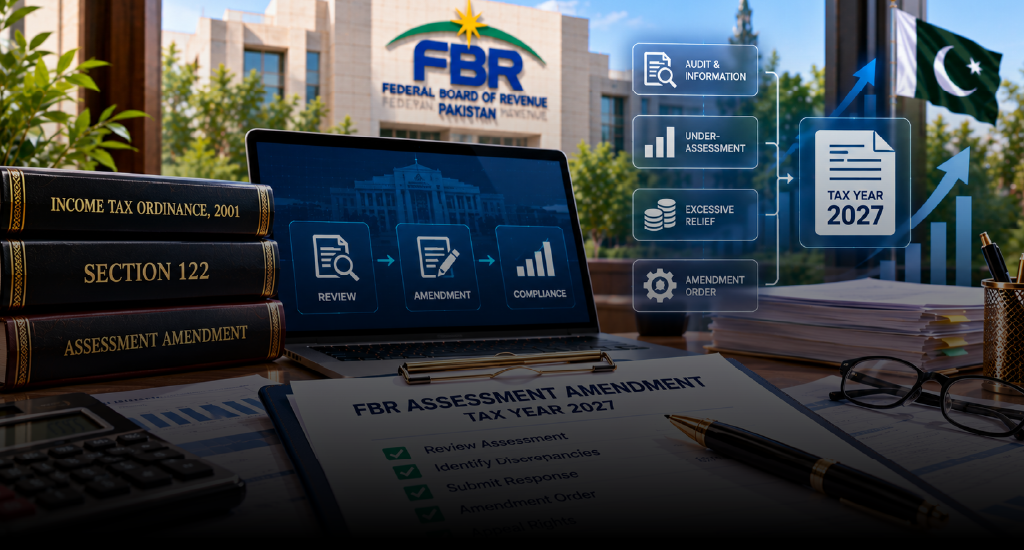
The Federal Board of Revenue (FBR) can amend or further amend income tax assessment orders where specific legal grounds exist. Under Section 122 of the Income Tax Ordinance, 2001, the Commissioner may revise an assessment when taxable income has been under-assessed, tax has been charged incorrectly, excessive relief has been granted, or certain income has been misclassified.
For Tax Year 2027, taxpayers should understand when FBR can amend an assessment, the applicable time limits and the procedural safeguards available to taxpayers.
What Is an Amended Assessment?
An amended assessment is a revised tax assessment issued by the Commissioner after determining that an existing assessment requires changes.
Section 122 allows the Commissioner to amend an assessment order issued or treated as issued under Section 120, as well as an assessment made under Section 121.
The amendment can involve additions or alterations considered necessary under the law.
When Can FBR Amend an Assessment?
An assessment may be amended where, based on an audit or definite information, the Commissioner is satisfied that:
- Income chargeable to tax has escaped assessment.
- Total income has been under-assessed.
- Income has been assessed at an excessively low tax rate.
- Excessive relief or refund has been granted.
- An amount has been incorrectly classified under a head of income.
- The assessment is erroneous and prejudicial to the interests of revenue, where the relevant legal conditions are met.
These provisions allow FBR to correct assessments where the taxpayer’s declared tax position does not properly reflect the applicable law or available information.
What Is “Definite Information”?
The concept of definite information is important in Section 122 proceedings.
It can include information relating to:
- Sales and purchases
- Service receipts
- Other taxable receipts
- Acquisition or disposal of assets
- Money and valuable articles
- Investments
- Expenditure incurred by the taxpayer
Such information may provide the basis for FBR to identify discrepancies requiring an assessment amendment.
Five-Year Time Limit
Generally, an assessment order cannot be amended after the expiry of five years from the end of the financial year in which the original assessment order was issued or treated as issued.
Where an assessment has already been amended, further amendment may also be possible within the time limits prescribed under Section 122.
Taxpayers should therefore carefully review the relevant assessment dates when responding to an amendment proceeding.
Taxpayer Must Be Given an Opportunity of Being Heard
An important safeguard under Section 122 is the taxpayer’s right to be heard.
FBR must generally provide the taxpayer an opportunity to present an explanation and supporting evidence before an assessment is amended under the relevant provisions.
Taxpayers should use this opportunity to address discrepancies and submit appropriate documentation before an amended assessment order is issued.
Time Limit After Show-Cause Notice
An assessment amendment order should generally be made within one year from the issuance of the show-cause notice.
The Commissioner may extend this period for recorded reasons, but the extension cannot exceed 90 days, subject to exclusions and conditions provided under the law.
Revised Returns and Amended Assessments
Where a taxpayer submits a revised return under the applicable provisions of Section 114, the law may treat the revised return as an amended assessment.
The revised return can be treated as an amended assessment order issued by the Commissioner on the date it is furnished, subject to the relevant provisions of the Income Tax Ordinance.
What Must an Amended Assessment Order Include?
Once an assessment is amended, the Commissioner must issue an amended assessment order specifying relevant details, including:
- Amended taxable income
- Amended tax payable
- Tax already paid, where applicable
- Time, place and manner for filing an appeal
This provides the taxpayer with the information required to understand the revised liability and consider available legal remedies.
What Should Taxpayers Do?
Taxpayers receiving an FBR assessment amendment notice should:
- Review the grounds stated in the notice.
- Compare the proposed changes with the original return.
- Gather invoices, financial statements and supporting records.
- Verify sales, purchases, investments and expenses.
- Review the source of any information relied upon by FBR.
- Submit a timely and properly documented response.
- Seek professional tax advice where the matter involves substantial tax exposure.
Ignoring an assessment amendment proceeding can increase the risk of an unfavorable tax outcome.
Xact Legal – Tax Assessment & Dispute Support
FBR assessment amendments can involve complex questions concerning taxable income, financial records, definite information, refunds, tax rates and classification of income.
Xact Legal provides professional assistance with FBR notices, amended assessments, tax audits, income tax compliance, appeals and tax disputes in Pakistan.
Received an FBR assessment amendment notice? Contact Xact Legal for professional tax and legal assistance.