
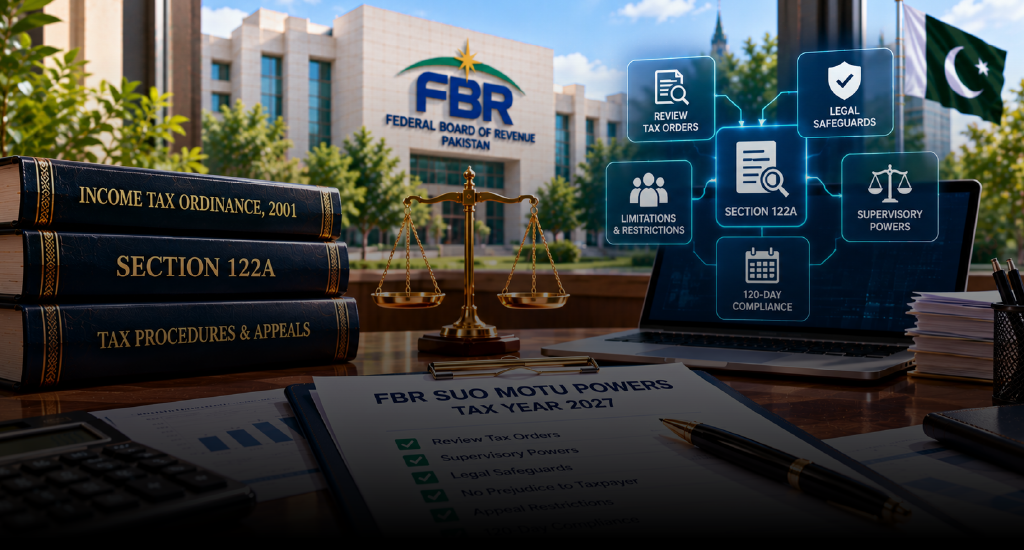
The Federal Board of Revenue (FBR) retains supervisory powers under Section 122A of the Income Tax Ordinance, 2001, allowing the Commissioner of Inland Revenue to review certain orders passed by Inland Revenue officers and revise them where legally justified.
For Tax Year 2027, these powers are subject to important legal safeguards, including restrictions on revisions that prejudice taxpayers and limitations where appeal proceedings are pending or the time for filing an appeal has not expired.
What Are FBR’s Suo Motu Powers?
The term suo motu means acting on one’s own initiative. Under Section 122A, the Commissioner may call for the record of proceedings conducted under the Income Tax Ordinance, 2001, or the repealed Income Tax Ordinance, where an order has been passed by an Inland Revenue officer.
After conducting any inquiry considered necessary, the Commissioner may revise the order if the circumstances justify such action under the law.
These powers provide a supervisory mechanism for reviewing tax orders and ensuring that proceedings are handled in accordance with the applicable legal framework.
When Can the Commissioner Exercise Section 122A Powers?
The Commissioner may examine relevant proceedings and consider whether an order requires revision.
The process may involve:
- Calling for the record of a tax proceeding.
- Examining an order passed by an Inland Revenue officer.
- Conducting an inquiry where necessary.
- Reviewing the circumstances surrounding the original order.
- Issuing a revised order where legally justified.
However, the existence of supervisory powers does not mean that every tax order can be revised without restrictions.
Important Safeguard: Revision Must Not Prejudice the Taxpayer
One of the most important protections under Section 122A is that an order issued through suo motu revision must not be prejudicial to the taxpayer concerned.
This safeguard limits the Commissioner’s revisionary authority and protects taxpayers against an adverse revision under this provision.
Taxpayers should understand the distinction between supervisory review under Section 122A and assessment amendment proceedings under other provisions of the Income Tax Ordinance.
When Is Suo Motu Revision Not Allowed?
Section 122A restricts the exercise of revisionary powers in certain appeal-related situations.
The Commissioner generally cannot revise an order where:
- An appeal against the order lies before the Commissioner (Appeals) or the Appellate Tribunal, and the prescribed time for filing that appeal has not expired.
- The matter is already pending before the Commissioner (Appeals).
- The order has become the subject of an appeal before the Appellate Tribunal.
These restrictions help prevent overlapping proceedings and preserve the statutory appeal process.
The 120-Day Deadline for Remanded Cases
Section 122A also provides a timeline for implementing directions when a matter is sent back to a lower authority.
Where the Commissioner remands an order for modification, alteration, implementation of directions or fresh proceedings, the lower authority must issue the order giving effect to those directions within 120 days.
This requirement supports timely implementation of revisionary decisions and helps reduce unnecessary delays in tax proceedings.
What Does Section 122A Mean for Taxpayers?
The provision highlights the importance of understanding both FBR’s supervisory powers and the legal protections available to taxpayers.
Individuals and businesses should:
- Keep copies of tax orders and related correspondence.
- Maintain complete financial and supporting records.
- Review the legal basis of any revisionary proceedings.
- Check whether appeal-related restrictions apply.
- Observe applicable deadlines for filing appeals.
- Seek professional advice before responding to complex tax proceedings.
A careful review of the relevant order and procedural history can help taxpayers understand their position and determine the appropriate next steps.
Section 122A vs. Section 122: Understanding the Difference
| Section | Purpose |
|---|---|
| Section 122A | Provides the Commissioner with suo motu revisionary powers over specified tax orders, subject to statutory safeguards. |
| Section 122 | Deals with amendment or further amendment of tax assessments where the legal requirements are satisfied. |
Understanding this distinction is important because the applicable procedure, grounds and taxpayer protections may differ depending on the provision involved.
Xact Legal – Tax Advisory and Dispute Support
FBR revisionary proceedings can involve complex questions concerning jurisdiction, assessment orders, appeal rights and statutory limitations.
Xact Legal provides professional assistance with income tax matters, FBR notices, assessment proceedings, tax appeals, compliance and regulatory disputes in Pakistan.
Our objective is to help individuals and businesses understand their tax obligations, assess available legal remedies and respond to tax proceedings with appropriate documentation.
Received an FBR order or facing a tax dispute? Contact Xact Legal for professional tax and legal assistance.