
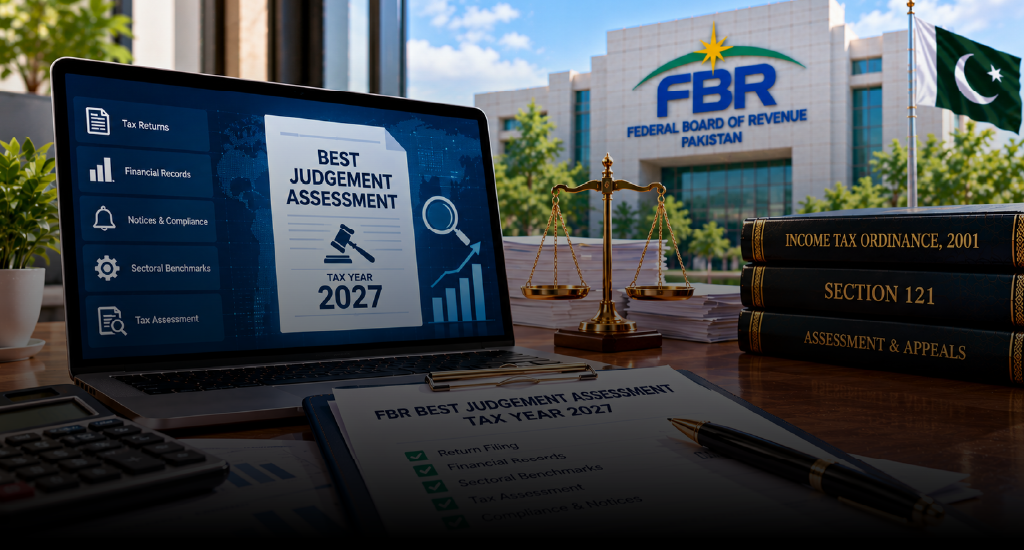
The Federal Board of Revenue (FBR) has strengthened the framework for best judgement assessment for Tax Year 2027. Under Section 121 of the Income Tax Ordinance, 2001, the Commissioner can determine a taxpayer’s taxable income and tax liability when required returns, statements, accounts or supporting records are not provided.
For taxpayers and businesses, the provision highlights the importance of timely tax filing, proper record keeping and responding to FBR notices within the prescribed requirements.
What Is a Best Judgement Assessment?
A best judgement assessment allows the Commissioner to determine a taxpayer’s taxable income and tax payable based on available information and material when the taxpayer fails to meet specified filing or documentation requirements.
This means FBR may determine the tax liability even when the taxpayer has not provided sufficient information to establish the correct taxable income.
When Can FBR Make a Best Judgement Assessment?
Under Section 121, the Commissioner may proceed with a best judgement assessment where a taxpayer fails to:
- File an income tax return in response to a notice under Section 114.
- File a return following the applicable business discontinuation requirements under Section 117.
- Submit a return required under Sections 143 or 144.
- Furnish a wealth statement or other statement required under Section 116.
- Produce accounts, documents, records or other evidence required for determining taxable income and tax payable.
FBR Can Use Available Information
When making a best judgement assessment, the Commissioner can rely on available information or material to determine the taxpayer’s income and tax liability.
This can make accurate financial records particularly important for businesses and individuals facing tax proceedings.
Where the requirements for a best judgement assessment have been triggered, an assessment otherwise treated as having been made on the basis of a return or revised return may have no legal effect.
Sectoral Benchmark Ratios
One of the important features of Section 121 is the ability of the Commissioner to determine taxable income using sectoral benchmark ratios prescribed by FBR.
These benchmarks may include:
- Financial ratios
- Production ratios
- Gross profit ratios
- Net profit ratios
- Recovery ratios
- Wastage ratios
- Other sector-specific benchmarks
This allows the tax authority to compare a taxpayer’s reported financial position with established benchmarks for the relevant business sector.
What Must an Assessment Order Contain?
After making a best judgement assessment, the Commissioner is required to issue an assessment order to the taxpayer.
The order should specify:
- Taxable income
- Amount of tax due
- Tax already paid, where applicable
- Time, place and manner for filing an appeal
This gives the taxpayer information about the assessment and the applicable appeal process.
Time Limit for Best Judgement Assessment
For Tax Year 2027, an assessment order under Section 121 is generally subject to a six-year limitation period after the end of the relevant tax year or income year.
A special limitation applies in certain cases involving notices under Section 114 concerning one or more of the last ten completed tax years. In such circumstances, the assessment order may be subject to a two-year period from the end of the tax year in which the notice was issued.
What Should Taxpayers Do?
Taxpayers can reduce the risk of a best judgement assessment by maintaining proper tax and financial records and responding promptly to FBR requirements.
Businesses and individuals should:
- File income tax returns on time.
- Maintain complete books and financial records.
- Keep invoices, receipts and supporting documents.
- Maintain accurate wealth statements.
- Respond to FBR notices within the prescribed period.
- Reconcile declared income with financial records.
- Keep evidence supporting major transactions and expenses.
- Seek professional assistance when facing an audit or assessment.
Why Best Judgement Assessment Matters
Section 121 gives FBR a mechanism to determine tax liability when taxpayers fail to provide the information required for a proper assessment.
For businesses, this makes accurate accounting records, sector-specific financial reporting and timely tax compliance increasingly important.
A taxpayer who receives a notice should not ignore it, as failure to provide the required information can expose the taxpayer to an assessment based on information available to FBR.
Xact Legal – Tax Assessment & Compliance Support
Facing an FBR best judgement assessment can have significant financial and legal consequences. Professional review of the notice, financial records and applicable tax position can help taxpayers respond appropriately.
Xact Legal provides professional assistance with FBR notices, tax audits, assessments, income tax returns, wealth statements, tax disputes and regulatory compliance in Pakistan.
Received an FBR assessment notice? Contact Xact Legal for professional tax and legal assistance.