

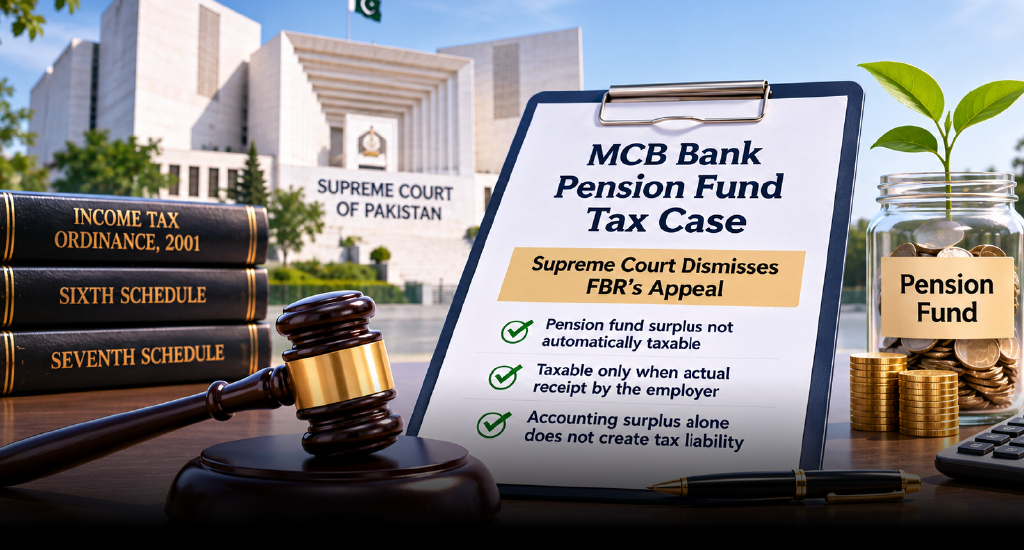
The Supreme Court of Pakistan has dismissed the Federal Board of Revenue’s (FBR) appeal against MCB Bank in a significant pension fund taxation case. The Court ruled that a surplus generated in a pension fund cannot automatically be treated as the bank’s taxable income unless the amount is actually received back by the employer.
The judgment, authored by Justice Aqeel Ahmed Abbasi, upheld the Lahore High Court’s decision in favour of MCB Bank.
Why Was the Case Important?
The dispute concerned the tax treatment of a surplus arising in a pension fund maintained by the bank. Pension fund assets and liabilities may be assessed periodically, and accounting standards can result in a reported surplus.
The key legal question was whether recognising such a surplus in financial statements was sufficient to make it taxable income.
What Did the Supreme Court Decide?
The Supreme Court clarified several important points:
- Actual receipt matters: Under Rule 4 of Part II of the Sixth Schedule to the Income Tax Ordinance, 2001, the relevant employer contributions and income earned on those contributions become taxable when actually received back by the employer.
- Accounting surplus is not automatically taxable: A surplus identified through actuarial valuation does not, by itself, create a tax liability.
- Tax liability must have a legal basis: Accounting standards, including IAS 19, cannot independently establish a tax liability without support from applicable tax legislation.
- Special tax regime considered: Although banks are subject to the Seventh Schedule of the Income Tax Ordinance, the Court found no specific provision there governing pension fund surpluses. The relevant Sixth Schedule provisions therefore applied through Rule 9 of the Seventh Schedule.
What Does the Judgment Mean for Businesses?
The ruling reinforces the principle that tax liability must be determined according to the applicable law rather than accounting entries alone.
Businesses that maintain pension funds or other employee benefit arrangements should carefully review their accounting treatment, tax provisions and applicable statutory requirements. A surplus reported in financial statements should not automatically be assumed to be taxable or non-taxable without examining the relevant legal provisions and circumstances.
How Xact Legal Can Help
Xact Legal provides tax and legal advisory services to businesses in Pakistan. Our team can assist with reviewing tax positions, understanding relevant provisions of the Income Tax Ordinance, 2001, and assessing tax disputes involving financial reporting and statutory interpretation.
Professional review can help businesses identify potential tax risks, maintain appropriate documentation and make informed decisions about their tax obligations.
Frequently Asked Questions
What did the Supreme Court decide in the MCB Bank pension fund case?
The Court dismissed the FBR’s appeal and held that a pension fund surplus cannot automatically be treated as the bank’s taxable income unless the relevant amount is actually received back by the employer.
Is a pension fund surplus automatically taxable in Pakistan?
No. According to this judgment, recognising a surplus through actuarial valuation does not, by itself, create a tax liability. The applicable statutory provisions and actual circumstances must be considered.
Which tax law provisions were relevant?
The case involved Rule 4 of Part II of the Sixth Schedule and Rule 9 of the Seventh Schedule to the Income Tax Ordinance, 2001.
Conclusion
The Supreme Court’s decision in the MCB Bank pension fund case highlights the importance of interpreting tax legislation carefully. It confirms that accounting recognition alone does not establish taxable income where the applicable law requires actual receipt.
Businesses should review their pension fund arrangements and tax positions in light of the relevant legislation and judicial interpretation.
Disclaimer: This article is for general informational purposes only and does not constitute legal or tax advice. The application of the judgment depends on the relevant facts and applicable law.