
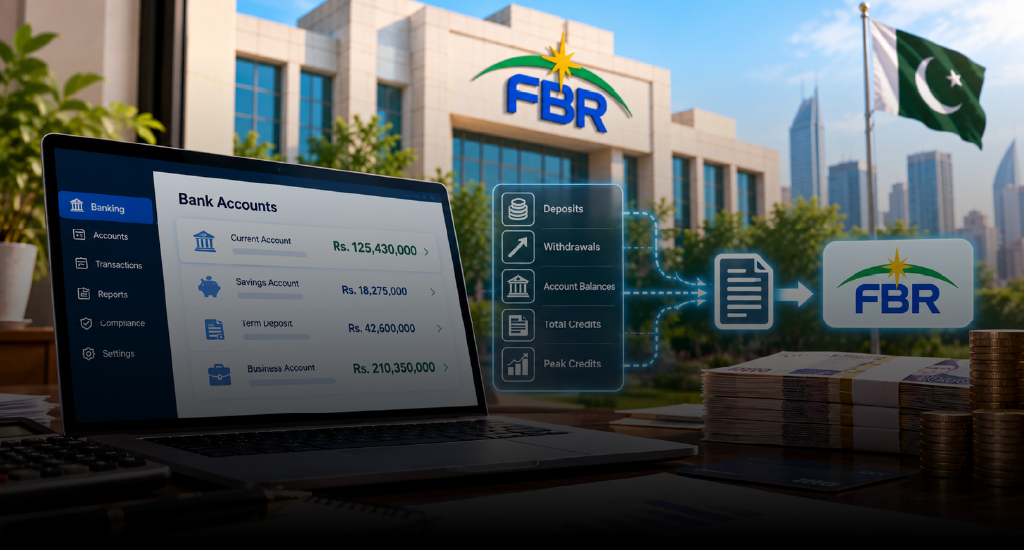
The Federal Board of Revenue (FBR) is introducing a digital reporting framework for high-value bank account activity in Pakistan under Section 165AB of the Income Tax Ordinance, 2001. For Tax Year 2027, banks and Electronic Money Institutions (EMIs) must electronically report specified financial information for account holders whose aggregate deposits or withdrawals exceed Rs. 100 million during a six-month reporting period.
The measure aims to strengthen tax compliance by using automated systems to compare banking information with taxpayers’ declared financial records. Individuals and businesses with substantial banking activity should understand the reporting requirements and maintain accurate financial documentation.
What Is Section 165AB of the Income Tax Ordinance?
Section 165AB establishes a reporting mechanism requiring banks and EMIs to submit prescribed financial information to the FBR’s Central Data Hub.
Tax Year 2027 runs from July 1, 2026, to June 30, 2027. The new framework is designed to identify potential discrepancies between reported banking activity and declared income, assets and other tax information.
Who Is Covered by the Rs. 100 Million Reporting Threshold?
The reporting requirement applies when an account holder’s aggregate deposits or withdrawals exceed Rs. 100 million during the relevant six-month reporting period, across one or more bank accounts.
The framework covers different types of deposit accounts, including:
- Current accounts
- Savings accounts
- Fixed and term deposit accounts
- Call deposit accounts
- Other prescribed deposit accounts
Banks and EMIs are responsible for submitting the required information in the prescribed electronic format.
What Banking Information Will Be Reported to the FBR?
The information submitted under Section 165AB includes key details about account activity and balances.
1. Deposits and Withdrawals
Financial institutions must report prescribed details of deposits and withdrawals recorded during the relevant reporting period.
2. Opening and Closing Balances
The information includes account balances at the beginning and end of the reporting period, helping the system assess changes in an account holder’s financial position.
3. Peak Credits
Peak credits refer to the highest credit balance across an account holder’s bank accounts on a particular date during the reporting period.
4. Total Credits
Banks and EMIs must also report the total credits recorded during the relevant period as required under the framework.
This information supports automated financial analysis and comparison with available tax records.
What Are the FBR Bank Reporting Dates for 2027?
The reporting framework divides the year into two six-month periods.
| Reporting period | Submission deadline |
|---|---|
| July 1 to December 31, 2026 | January 31, 2027 |
| January 1 to June 30, 2027 | July 31, 2027 |
These deadlines relate to the reporting obligations of financial institutions. They are not individual income tax return filing deadlines.
How Will the FBR Use Bank Account Information?
The reported information is processed through the FBR’s Central Data Hub for automated cross-matching with relevant tax and financial records.
During the initial automated screening stage, the information is not accessible to income tax authorities. If the system identifies a significant mismatch, the relevant case may be referred to the FBR’s Compliance Risk Management system for further examination and possible proceedings through the National Faceless Centre.
Potential compliance concerns may include:
- Income that appears inconsistent with banking activity
- Undeclared assets or financial resources
- Underreported business sales or receipts
- Expenses that may not align with available financial records
A mismatch does not automatically establish tax evasion or additional tax liability. The circumstances and supporting evidence must be considered before any conclusion is reached.
What Should Individuals and Businesses Do?
Individuals, business owners and companies with substantial banking transactions should take practical steps to maintain transparent and consistent financial records.
- Keep bank statements and transaction records organized.
- Reconcile business receipts with accounting records and tax returns.
- Retain invoices, contracts and other evidence supporting large deposits.
- Document legitimate sources of funds, including loans, investments and transfers.
- Review declared income and assets for consistency with financial activity.
- Seek professional tax advice if the FBR requests clarification or supporting documentation.
Good recordkeeping can help taxpayers explain the nature and source of their financial transactions when required.
Are Bank Account Details Kept Confidential?
The reporting framework includes confidentiality safeguards for financial information received by the FBR. The law requires the information to be protected against unauthorized disclosure or misuse, subject to the applicable statutory provisions.
Taxpayers should understand that the purpose of automated reporting is to identify potential compliance risks. Being covered by the reporting threshold does not, by itself, mean that a person has committed a tax offence.
How Can Xact Legal Help?
Keeping banking activity, accounting records and tax declarations consistent is increasingly important as Pakistan strengthens its digital tax administration systems.
Xact Legal helps individuals and businesses understand Pakistan’s tax regulations, organize supporting documentation and address tax compliance matters. Professional guidance can help taxpayers review their financial records and respond appropriately to questions about high-value transactions.
Contact Xact Legal for tax advisory and compliance support tailored to your circumstances.