
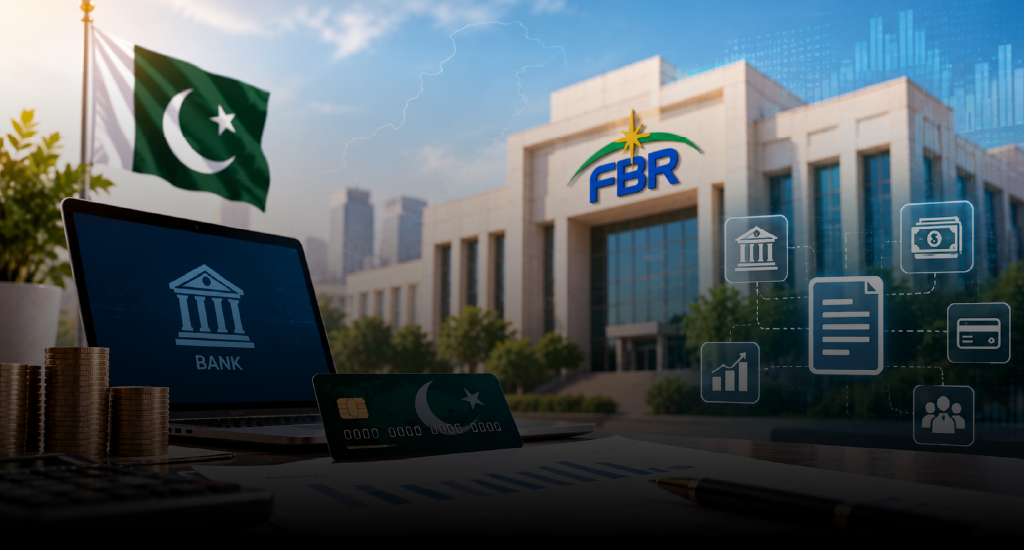
The Federal Board of Revenue (FBR) has outlined the banking information reporting requirements applicable to Tax Year 2027 in Pakistan. Under Section 165A of the Income Tax Ordinance, 2001, banks are required to report specified financial transactions and account-related information to the tax authority.
These requirements help the FBR monitor tax compliance and compare reported financial activity with taxpayers’ declared income. Understanding the rules can help individuals and businesses maintain accurate financial records and prepare for potential tax queries.
What Is Section 165A of the Income Tax Ordinance?
Section 165A establishes reporting obligations for banking companies, requiring them to provide specified information to the FBR in the prescribed form and manner.
The provision applies during Tax Year 2027, which runs from July 1, 2026, to June 30, 2027.
Which Bank Transactions Must Be Reported to the FBR?
Under the reporting framework described for Tax Year 2027, banks must provide information about the following categories:
1. Cash Withdrawals
Banks must report individuals making cash withdrawals exceeding Rs. 50,000 in a day where their aggregate cash withdrawals reach Rs. 1 million or more during the preceding calendar month. The applicable tax deducted must also be reported.
2. Large Bank Deposits
Banks must report account holders whose total deposits reach Rs. 10 million or more during the preceding calendar month.
3. Credit Card Payments
Credit card bill payments aggregating Rs. 200,000 or more during the preceding calendar month fall within the reporting requirements.
4. Profit on Debt
Banks must provide information about individuals receiving profit on debt during the preceding financial year, along with details of tax deducted.
5. Newly Opened or Redesignated Business Accounts
Banks must also report business accounts opened or redesignated during the preceding calendar month.
What Does This Mean for Individual Taxpayers?
Bank reporting does not automatically mean that a taxpayer has violated tax laws or owes additional tax. However, financial transactions may be relevant when the FBR reviews whether a person’s declared income and financial activity are consistent.
Taxpayers should maintain supporting documentation for significant deposits, transfers, business receipts, investments and other financial transactions.
Where necessary, documents such as bank statements, invoices, contracts, loan agreements and records of gifts or other legitimate sources of funds can help explain the nature and source of money.
What Should Businesses Do to Stay Tax-Compliant?
Businesses should take a proactive approach to financial recordkeeping and tax compliance. Recommended steps include:
- Maintain accurate bank statements and accounting records.
- Reconcile bank transactions with sales, income and declared financial information.
- Keep supporting documents for significant deposits and transfers.
- Separate personal and business transactions wherever practical.
- Review tax returns for consistency with financial records.
- Seek professional advice if the FBR requests an explanation or supporting documents.
Are Bank and Account Holder Information Confidential?
The reporting framework requires banks to provide specified information to the FBR. Information received by the tax authority is subject to applicable confidentiality requirements and restrictions on its use under the Income Tax Ordinance, 2001.
Taxpayers should understand that the reporting requirements apply to specified categories of transactions and information. The applicable thresholds and legal provisions should be reviewed in context rather than interpreted as proof of wrongdoing.
How Can Xact Legal Help?
Understanding FBR bank reporting requirements can be important for individuals, business owners and companies seeking to maintain accurate tax records. Proper documentation and professional guidance can help taxpayers respond appropriately to questions about financial transactions and declared income.
Xact Legal provides tax and corporate advisory support to help individuals and businesses understand Pakistan’s tax regulations, organize financial documentation and manage their tax compliance responsibilities.
Contact Xact Legal for professional assistance with tax compliance, documentation and related advisory matters.