
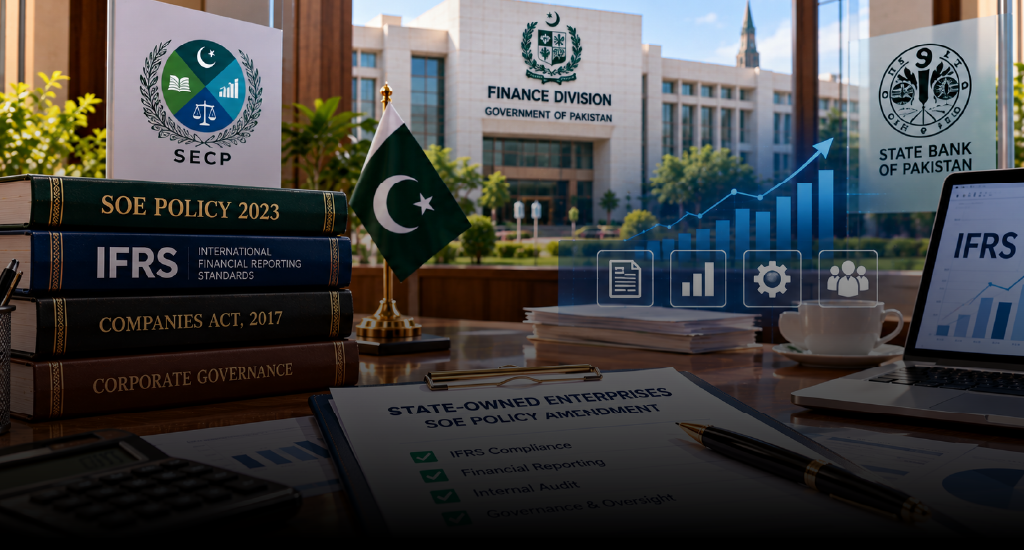
Pakistan’s Finance Division has amended the State-Owned Enterprises (SOEs) Ownership and Management Policy, 2023 to strengthen the implementation of International Financial Reporting Standards (IFRS) across state-owned enterprises.
The amendment introduces clearer financial reporting requirements while maintaining the regulatory authority of the State Bank of Pakistan (SBP).
What Has Changed in the SOE Policy?
The amendment replaces Paragraph 31 of the SOEs Ownership and Management Policy 2023 and establishes a revised framework for IFRS implementation.
Under the amended policy, IFRS applicable to SOEs refers to the financial reporting standards notified by the Securities and Exchange Commission of Pakistan (SECP) under Section 225 of the Companies Act, 2017.
This provides SOEs with a clearer and more consistent financial reporting framework.
SECP Modifications Will Apply to SOEs
The revised policy also clarifies that modifications, exemptions or other financial reporting provisions granted by SECP to companies generally under Section 225 will also apply to SOEs registered under the Companies Act, 2017.
This can help align SOE financial reporting with the wider corporate regulatory framework.
SBP-Regulated Entities Have a Separate Framework
The amendment recognizes the specific regulatory position of entities governed by the State Bank of Pakistan.
For SBP-regulated institutions, the statutory financial reporting framework prescribed by SBP under the Banking Companies Ordinance, 1962 will prevail where there is an inconsistency with other financial reporting requirements.
The amendment does not restrict SBP’s statutory powers or regulatory authority.
Finance Division to Develop Financial Management Framework
The Finance Division has also been tasked with developing a detailed financial management framework for statutory SOEs in consultation with the Auditor General of Pakistan.
The framework is expected to provide further guidance on financial management, reporting and oversight requirements.
Stronger Internal Audit Requirements
The amended policy emphasizes the establishment of appropriate internal audit procedures and mechanisms in accordance with the State-Owned Enterprises (Governance and Operations) Act, 2023.
This places greater focus on:
- Internal controls
- Financial oversight
- Risk management
- Accountability
- Governance and compliance
Why IFRS Compliance Matters for SOEs
Stronger IFRS-based reporting can help SOEs improve:
- Financial transparency
- Consistency of financial statements
- Corporate governance
- Internal financial controls
- Financial risk assessment
- Stakeholder confidence
- Accountability
A consistent reporting framework can also make financial information easier to understand and compare across organizations.
What Should SOEs Do?
State-owned enterprises should review their current financial reporting and governance practices to determine whether they align with the amended policy.
Key steps include:
- Review applicable IFRS requirements.
- Assess existing accounting and reporting procedures.
- Identify relevant SECP modifications or exemptions.
- Strengthen internal audit mechanisms.
- Review financial controls.
- Ensure compliance with sector-specific regulations.
- Monitor further guidance from the Finance Division.
Xact Legal – Corporate & Regulatory Advisory
The amended SOE policy highlights the growing importance of financial reporting, internal controls and regulatory compliance for state-owned enterprises.
Xact Legal provides professional corporate, legal, regulatory and compliance advisory services to help organizations understand regulatory changes and strengthen their governance frameworks.
Need assistance with corporate compliance or regulatory requirements? Contact Xact Legal for professional advisory support.