

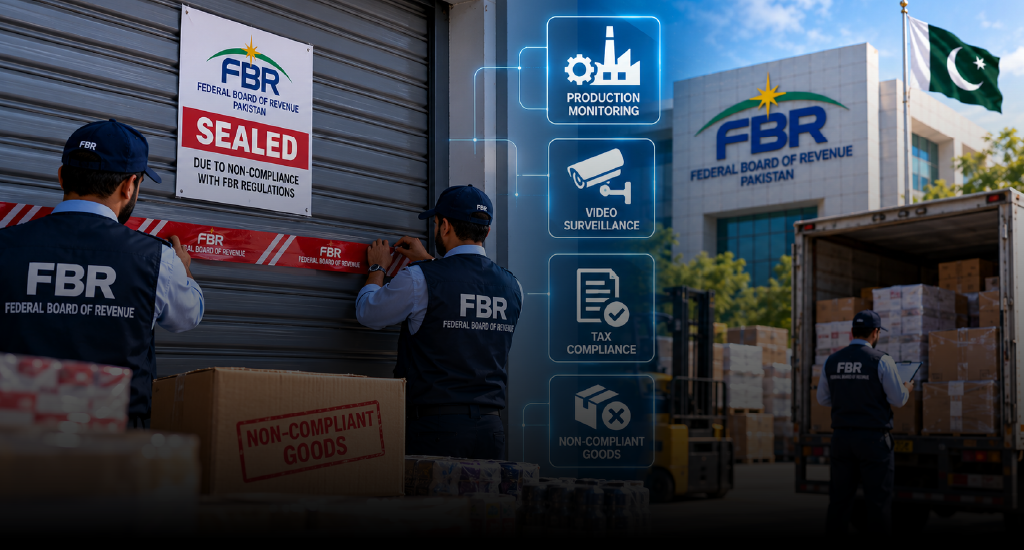
The Federal Board of Revenue (FBR) has introduced new procedures for sealing non-integrated business premises and seizing non-compliant goods under amendments to the Sales Tax Rules, 2006.
Through SRO 1662(I)/2026, FBR has established procedures for sealing and de-sealing premises, electronic production monitoring, and the seizure and confiscation of goods and vehicles involved in specified violations.
When Can Business Premises Be Sealed?
Where a person required to integrate with FBR’s prescribed monitoring system fails to comply, the Commissioner Inland Revenue may initiate sealing proceedings.
An Inland Revenue officer not below the rank of Assistant Commissioner must submit a written report explaining the circumstances and reasons for the proposed action.
The Chief Commissioner Inland Revenue then decides whether to approve or reject the sealing proposal through a written order.
Requirements for De-Sealing
A sealed premises generally remains closed until the applicable:
- Prescribed penalty is imposed and paid
- Required monitoring system is integrated with FBR’s computerized system
- Technical and functional requirements are verified
Integration must take place in the presence of an FBR team, including a technical expert. The Commissioner must subsequently issue a certificate confirming proper installation and integration.
Electronic Production Monitoring
The amended rules expand the use of production monitoring systems, video surveillance, video analytics, digital eye technology and other prescribed mechanisms.
These systems can monitor production, sales, stock and clearances, record production interruptions or tampering, and transmit relevant information to FBR’s designated systems.
Businesses covered by the regime must obtain monitoring equipment through FBR-authorised vendors and provide access to their premises for installation, inspection, maintenance and upgrades.
Non-Compliant Goods and Vehicles Can Be Confiscated
Specified taxable goods manufactured, transported, supplied or otherwise dealt with outside the prescribed monitoring system may be seized and confiscated under Section 40C of the Sales Tax Act, 1990.
Vehicles or other means of transport used to move such goods may also be subject to seizure and confiscation following adjudication.
Seizure and Adjudication Process
The rules require the authorised officer to document the seizure through an inventory and seizure memorandum.
Key timelines include:
- Within 48 hours: Seized goods should be transferred to an authorised Inland Revenue officer or designated facility.
- Within 7 days: A show-cause notice must generally be issued.
- At least 14 days: The recipient must be given to submit a reply.
- Within 30 days: Adjudication should ordinarily be completed.
- Up to 15 additional days: An extension may be granted in specified circumstances.
What Businesses Should Do
Businesses covered by FBR’s monitoring requirements should ensure that their systems, tax identification requirements and production records remain compliant.
Businesses should:
- Complete required system integration
- Use FBR-authorised vendors
- Maintain accurate production and inventory records
- Ensure prescribed tax stamps, labels and barcodes are properly applied
- Keep supporting documentation readily available
- Respond promptly to FBR notices and proceedings
Xact Legal – Tax Compliance & Advisory
Xact Legal provides professional tax advisory, sales tax compliance and audit support services in Pakistan, helping businesses understand FBR requirements, manage documentation and respond to tax compliance matters.