
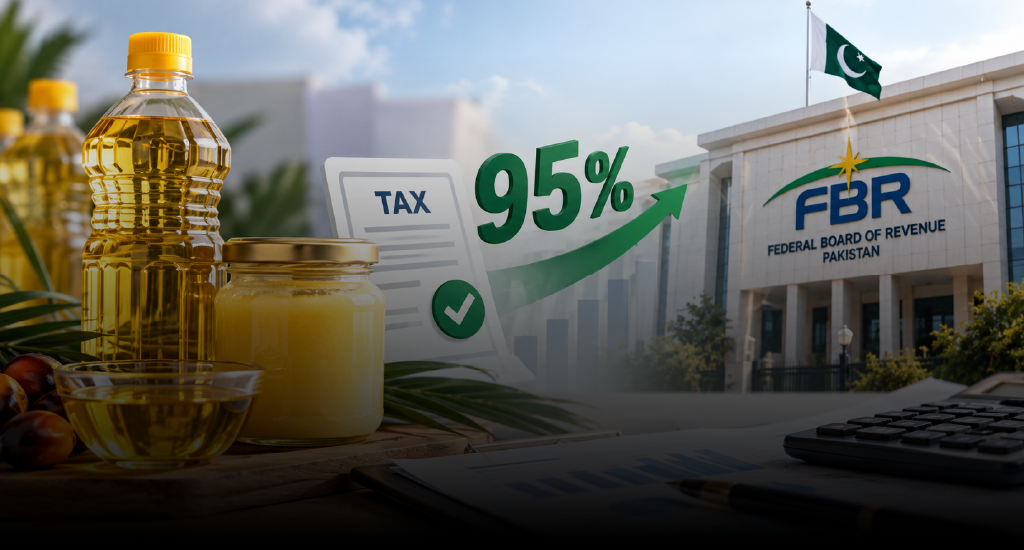
The Federal Board of Revenue (FBR) has introduced an important sales tax relief measure for compliant oil and ghee manufacturers and suppliers, allowing eligible businesses to adjust input tax up to 95% of their output tax for the relevant tax period.
The measure was introduced through SRO 1631(I)/2026 dated September 18, 2026, which amends SRO 1190(I)/2019 under the Sales Tax Act, 1990. The facility is subject to specific compliance requirements and is currently available until November 30, 2026.
What Has FBR Changed?
Under the latest amendment, FBR has added a new entry to Table-2 of SRO 1190(I)/2019, extending the 95% input tax adjustment facility to eligible businesses involved in the supply of oil and ghee.
The measure applies to registered persons that meet the conditions prescribed by FBR, particularly businesses that are:
- Engaged in the supply of oil and ghee;
- Compliant with FBR’s digital invoicing requirements;
- Compliant with the applicable production monitoring system; and
- Paying sales tax at retail price under Serial No. 56 of the Third Schedule to the Sales Tax Act, 1990.
95% Input Tax Adjustment Explained
Input tax is the sales tax paid by a registered business on eligible purchases and inputs used in making taxable supplies.
Under the latest FBR measure, eligible oil and ghee businesses can adjust input tax up to 95% of their output tax for the relevant tax period.
Where admissible input tax exceeds the amount that can be adjusted within the applicable limit, the excess amount is carried forward to the following tax period, subject to the applicable law and conditions.
This can have an important impact on the sales tax position and working capital management of businesses operating in the edible oil and ghee sector.
Digital Compliance Is a Key Condition
One of the significant aspects of the latest measure is its connection with digital tax compliance.
Businesses seeking to benefit from the 95% input tax adjustment facility must comply with FBR’s applicable digital invoicing and production monitoring requirements.
FBR has also been advancing production monitoring and digital tracking requirements in the edible oil and ghee sector. Its 2026 procurement documents provide for systems capable of monitoring production, measuring volumes and counting finished goods for taxation and regulatory purposes.
This indicates an increasing focus on connecting tax benefits with digitized records, production visibility and verifiable transaction data.
How the Measure May Affect Oil and Ghee Businesses
For eligible manufacturers and suppliers, the measure may help improve the management of sales tax liabilities and reduce the amount of input tax that remains unadjusted in a tax period.
However, businesses should ensure that their:
- Sales tax registrations are properly maintained;
- Digital invoices comply with FBR requirements;
- Production records are accurate and complete;
- Input tax claims are properly documented;
- Output tax calculations are accurate;
- Retail-price taxation requirements are correctly applied; and
- Sales tax returns accurately reflect eligible adjustments.
Proper documentation is particularly important because input tax adjustment remains subject to the conditions and limitations prescribed under the Sales Tax Act, 1990 and relevant notifications.
Facility Available Until November 30, 2026
The 95% input tax adjustment facility introduced through the latest amendment is available to qualifying oil and ghee businesses until November 30, 2026.
Businesses should therefore review the applicable requirements and ensure that their tax and digital compliance systems are aligned with the conditions before claiming the facility.
What Businesses Should Do
Oil and ghee manufacturers and suppliers should consider conducting a review of their current sales tax and digital compliance position.
Key areas to review include:
- Input tax records – Verify that input tax claims are supported by valid documentation.
- Output tax calculations – Ensure sales tax is correctly calculated on taxable supplies.
- Digital invoicing – Review compliance with FBR’s applicable digital invoicing requirements.
- Production monitoring – Ensure required production data is accurately captured and reported.
- Sales tax returns – Reconcile input and output tax before filing returns.
- Carry-forward amounts – Properly track any input tax that remains unadjusted.
- Regulatory updates – Monitor subsequent FBR notifications and amendments affecting the facility.
Xact Legal – Tax & Corporate Compliance Support
Changes in sales tax rules can have a direct impact on a business’s tax position, documentation requirements and compliance processes.
Xact Legal assists businesses with tax and corporate compliance matters, including sales tax compliance, tax advisory, corporate compliance and regulatory requirements in Pakistan.
Professional tax guidance can help businesses understand applicable rules, maintain proper documentation and structure their compliance processes in accordance with current requirements.
Conclusion
FBR’s decision to allow eligible oil and ghee businesses to adjust input tax up to 95% of output tax represents an important development for the edible oil and ghee sector.
The facility is not automatic for every business. Eligibility is linked to specific conditions, including compliance with digital invoicing, production monitoring and retail-price sales tax requirements.
Businesses operating in this sector should review their compliance systems and documentation before claiming the benefit and continue monitoring FBR notifications for further changes.
Need assistance with sales tax or corporate compliance in Pakistan? Contact Xact Legal for professional tax and legal support.