

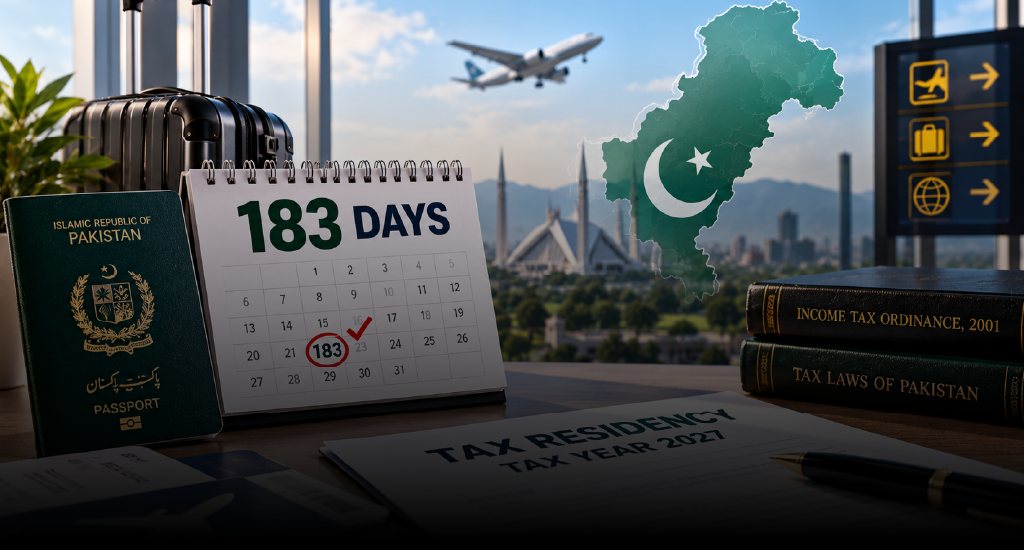
The Federal Board of Revenue (FBR) has outlined the rules for determining tax residency in Pakistan for Tax Year 2027 under Sections 81 to 84 of the Income Tax Ordinance, 2001. For individuals, the 183-day rule remains a key test for determining whether a person is a resident taxpayer.
What Is the 183-Day Tax Residency Rule?
Under Section 82, an individual is generally considered a resident individual if they are physically present in Pakistan for 183 days or more during the tax year.
The 183 days do not have to be consecutive. Multiple periods of stay can be aggregated to meet the 183-day threshold.
Other Rules Can Determine Tax Residency
The 183-day test is not the only criterion under Pakistan’s tax law.
An individual may also be treated as a resident if they are an employee or official of the Federal or Provincial Government posted abroad during the tax year.
Specific rules also apply to Pakistani citizens. A Pakistani citizen may be treated as a resident if they are not present in another country for more than 182 days during the tax year or if they are not a resident taxpayer of another country.
Tax Residency Rules for Companies and AOPs
Different tests apply to companies and Associations of Persons (AOPs):
Companies: A company may be considered resident if it is incorporated or formed under Pakistani law, or if its control and management are wholly situated in Pakistan at any time during the tax year.
AOPs: An AOP is generally treated as resident where its control and management are wholly or partly situated in Pakistan.
Why Tax Residency Matters
Tax residency is an important factor in determining how Pakistan’s income tax rules apply to an individual, company or AOP.
Individuals with international travel, overseas employment, foreign income or connections with another country should carefully review their residency status for Tax Year 2027 rather than relying solely on the number of days spent in Pakistan.
Xact Legal – Tax Compliance Support
Determining tax residency can involve more than simply counting days of physical presence.
Xact Legal provides professional tax and legal services in Pakistan, helping individuals and businesses understand their tax obligations and comply with applicable income tax laws.
Need help determining your tax residency or Tax Year 2027 obligations? Contact Xact Legal for professional guidance.