
Companies in Pakistan may face a tax liability based on more than their conventional taxable income. Under Section 113C of the Income Tax Ordinance, 2001, the Alternative Corporate Tax (ACT) regime requires certain companies to compare their normal corporate tax liability with tax calculated on their accounting income.
For Tax Year 2027, the Alternative Corporate Tax rate remains 17%, making the calculation an important consideration when preparing corporate tax returns.
What Is Alternative Corporate Tax?
Alternative Corporate Tax is a separate tax mechanism designed to ensure that eligible companies with significant accounting profits but relatively lower taxable income do not have an unexpectedly low tax liability.
Under Section 113C, the company is generally required to pay the higher of Corporate Tax or Alternative Corporate Tax.
The ACT calculation begins with the company’s accounting profit before tax, as disclosed in its financial statements, subject to adjustments prescribed under the law.
How Is ACT Calculated?
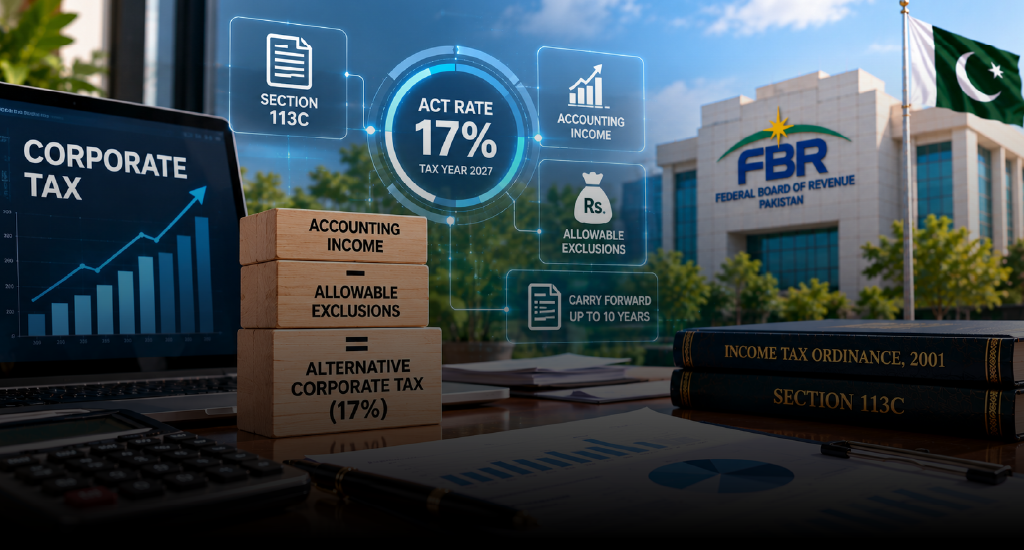
The basic ACT framework applies a 17% rate to accounting income after making the exclusions and adjustments permitted under Section 113C.
In simple terms:
Accounting Income – Permitted Exclusions = ACT Base
ACT Base × 17% = Alternative Corporate Tax
The final liability is then determined by comparing ACT with the company’s Corporate Tax liability. The higher amount becomes payable under the applicable framework.
Which Amounts Can Be Excluded?
Section 113C provides for certain exclusions when calculating accounting income for ACT purposes.
These include:
- Exempt income
- Income subject to tax under provisions outside the specified corporate-tax/minimum-tax framework
- Income qualifying for certain tax credits, including those covered by Sections 65D, 65E and 100C
The calculation therefore requires more than simply applying 17% to the profit shown in the financial statements.
What Happens If ACT Is Higher?
If Alternative Corporate Tax is greater than the Corporate Tax payable for the tax year, the company pays the higher ACT amount.
However, the excess ACT is not necessarily lost.
The law allows qualifying excess ACT to be carried forward and adjusted against Corporate Tax in subsequent tax years. Any remaining eligible amount can continue to be carried forward for up to 10 succeeding tax years.
This makes accurate tracking of unused ACT particularly important for companies preparing returns in future years.
Certain Taxpayers Are Outside Section 113C
The Alternative Corporate Tax provisions do not apply to taxpayers whose income is taxed under the Fourth, Fifth and Seventh Schedules of the Income Tax Ordinance.
Companies should therefore determine whether Section 113C applies to their specific tax profile before performing the ACT calculation.
FBR Can Review Accounting Income
The law also gives the Commissioner powers to make adjustments when determining accounting income based on the company’s historical accounting pattern, subject to providing the taxpayer an opportunity to be heard.
This makes consistent accounting records and proper financial documentation especially important for companies falling within the ACT regime.
What Companies Should Do for Tax Year 2027
Companies should not rely solely on their normal taxable-income calculation when finalising their Tax Year 2027 liability.
Businesses should:
- Calculate normal Corporate Tax
- Determine accounting income from financial statements
- Identify applicable ACT exclusions
- Calculate the 17% ACT
- Compare ACT with Corporate Tax
- Track any excess ACT carried forward
- Maintain supporting accounting and tax documentation
A proper comparison can help companies identify their actual tax exposure before filing their return.
Xact Legal – Corporate Tax Advisory
Alternative Corporate Tax calculations can become complex where accounting income differs significantly from taxable income.
Xact Legal provides professional corporate tax advisory and compliance services in Pakistan, helping companies evaluate Section 113C requirements, calculate tax liabilities and maintain proper documentation for FBR compliance.