

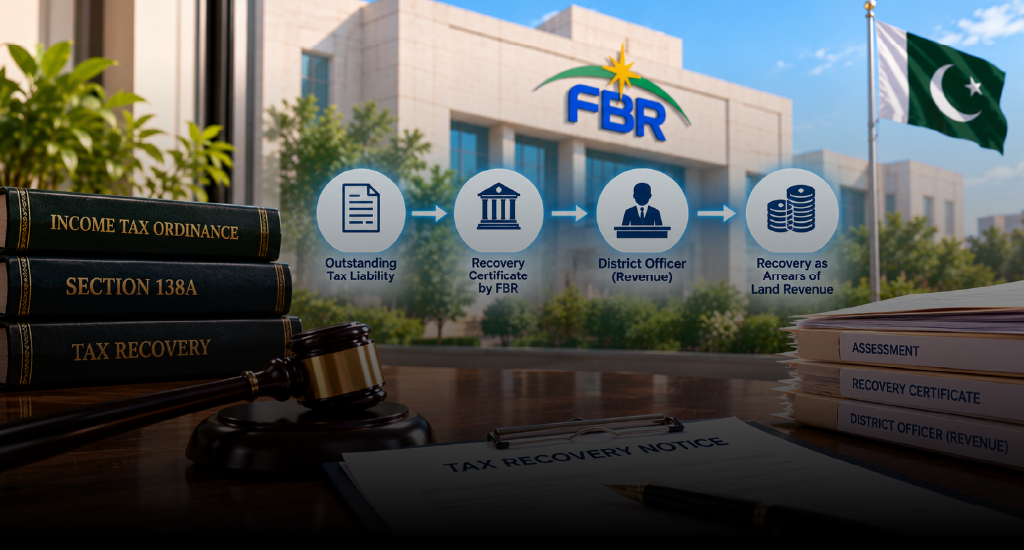
The Federal Board of Revenue (FBR) can recover outstanding income tax through a District Officer (Revenue) under Section 138A of Pakistan’s Income Tax Ordinance, 2001. This mechanism allows unpaid tax to be recovered in the same manner as an arrear of land revenue.
For Tax Year 2027, covering July 1, 2026, to June 30, 2027, taxpayers should understand how the process works, the powers of district revenue authorities and the rules governing tax liabilities in bankruptcy.
What Is Section 138A of the Income Tax Ordinance?
Section 138A provides a legal mechanism for the Commissioner Inland Revenue to refer outstanding tax liabilities to a District Officer (Revenue).
The Commissioner may issue a recovery certificate specifying the amount of tax due and forward it to the District Officer in the district where the taxpayer:
- Resides;
- Carries on business; or
- Owns property.
After receiving the certificate, the District Officer is required to recover the specified amount as an arrear of land revenue.
What Powers Does the District Officer Have?
Under Section 138A(2), the District Officer (Revenue) has powers similar to those of a civil court under the Code of Civil Procedure, 1908, for recovering amounts due under a decree.
These powers support the recovery of outstanding tax through the district revenue administration, subject to the applicable legal provisions.
The mechanism allows the FBR to pursue unpaid tax through the relevant district authority rather than relying exclusively on its own recovery processes.
How Does Tax Recovery Through a District Officer Work?
The process generally involves the following steps:
1. Outstanding Tax Liability
A tax amount remains unpaid and is subject to recovery under the Income Tax Ordinance, 2001.
2. Recovery Certificate
The Commissioner Inland Revenue forwards a certificate identifying the taxpayer and the amount due to the relevant District Officer (Revenue).
3. District-Level Recovery
The District Officer proceeds to recover the specified amount under the applicable land revenue recovery mechanism.
4. Recovery Under Legal Authority
The District Officer may exercise the relevant recovery powers available under the law, including powers comparable to those of a civil court for enforcing a decree.
Taxpayers should review the underlying tax demand and any notices or orders carefully. If they believe the demand is incorrect or that a legal safeguard applies, they should seek professional advice promptly.
What Happens to Tax Liability if a Taxpayer Is Declared Bankrupt?
Section 138B of the Income Tax Ordinance, 2001, addresses tax liabilities involving a taxpayer who has been declared bankrupt.
Under Section 138B:
- The taxpayer’s liability under the Ordinance passes to the estate in bankruptcy.
- Tax liability incurred by the bankrupt estate is treated as a current expenditure of the estate’s operations.
- The applicable tax must be paid before the claims of other creditors are settled, as provided by the law.
These provisions are important for bankruptcy administrators and other parties involved in managing an estate with outstanding tax obligations.
What Should Taxpayers Do About Outstanding FBR Tax Demands?
Individuals and businesses should take a proactive approach to managing tax liabilities and responding to recovery proceedings.
Recommended steps include:
- Review tax assessments, payment records and recovery notices.
- Confirm the amount outstanding and identify any payments already made.
- Keep tax returns, assessment orders and supporting financial documents organized.
- Seek professional advice if a tax demand is disputed.
- Respond promptly to communications from the FBR or district revenue authorities.
- Obtain advice on available appeal or other legal remedies where appropriate.
Early review and accurate documentation can help taxpayers understand their position and determine the appropriate next steps.
How Can Xact Legal Help?
FBR recovery proceedings can affect individuals, business owners and organizations with unpaid tax liabilities. Understanding the legal basis of a recovery certificate and the powers of the District Officer (Revenue) is important when deciding how to respond.
Xact Legal provides tax and corporate advisory support to help individuals and businesses understand Pakistan’s tax regulations, review compliance concerns and organize documentation relating to tax matters.
Contact Xact Legal for professional guidance on tax compliance, outstanding tax demands and related advisory matters.