

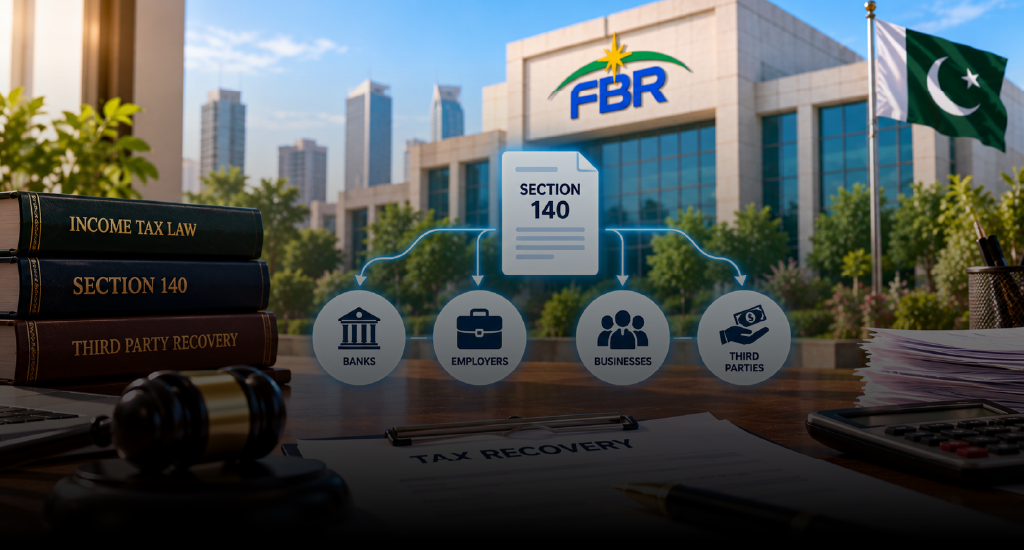
The Federal Board of Revenue (FBR) has the legal authority to recover outstanding income tax by directing certain third parties to pay money they owe to, or hold on behalf of, a taxpayer. This mechanism is provided under Section 140 of Pakistan’s Income Tax Ordinance, 2001.
For Tax Year 2027, covering July 1, 2026, to June 30, 2027, understanding these provisions is important for taxpayers, businesses, banks, employers and other parties that may hold funds belonging to someone with outstanding tax liabilities.
What Is Section 140 of the Income Tax Ordinance?
Section 140 allows the Commissioner Inland Revenue to issue a written notice requiring a person or organization to pay a specified amount directly to the tax authority toward a taxpayer’s outstanding tax liability.
The provision can apply when a third party:
- Owes money to a taxpayer.
- Holds money for or on behalf of a taxpayer.
- Holds money through another person for payment to the taxpayer.
- Has the authority to make payments to the taxpayer.
This mechanism allows the FBR to recover tax through money already owed or held for the taxpayer, subject to the applicable legal requirements.
Who Can Be Affected by Third-Party Tax Recovery?
Section 140 can apply to different types of individuals and organizations, depending on their financial relationship with the taxpayer.
Examples include:
- Banks: Where they hold funds belonging to a taxpayer.
- Employers: Where salary or other payments are due to an employee with outstanding tax liabilities.
- Businesses: Where they owe outstanding invoices or other payments to a taxpayer.
- Other persons or authorities: Where they hold or control money payable to the taxpayer.
Receiving a notice does not necessarily mean that the third party has committed an offence. However, the recipient must carefully review the notice and comply with its lawful requirements.
How Does the FBR Recover Tax Through Third Parties?
The recovery process generally follows these steps:
1. Outstanding Tax Liability
The process begins with tax remaining payable by a taxpayer under the applicable law.
2. Written Recovery Notice
The Commissioner may issue a written notice to a third party holding or owing money to the taxpayer. The notice specifies the amount to be paid and the payment date.
3. Payment Within the Legal Limits
The amount demanded must comply with Section 140. Where the money held is less than the outstanding tax, recovery is limited to the money available. Otherwise, the amount required should be sufficient to settle the outstanding liability, subject to the statutory provisions.
4. Payments in Installments
Where a third party makes a series of payments to the taxpayer, such as regular salary payments, the notice may specify amounts to be paid from successive payments until the outstanding tax is recovered.
5. Legal Discharge for the Third Party
Under Section 140(6), a third party complying with the notice is treated as having made the payment under the taxpayer’s authority. The Commissioner’s receipt provides a discharge of the third party’s liability to the taxpayer to the extent of the amount covered.
What Protections Are Available to Taxpayers?
Section 140 includes safeguards governing when recovery notices may be issued and how much can be recovered.
Protection During Certain Appeals
Where a taxpayer has filed an appeal under Section 127 against the order creating the tax liability, and the appeal remains undecided before the Commissioner (Appeals), the law restricts the issuance of a recovery notice under Section 140(1), provided the taxpayer has paid 10% of the tax due and the statutory conditions are met.
Taxpayers should verify whether these conditions apply to their particular case before relying on this protection.
Limits on Recovery Amounts
The recovery amount must be consistent with the outstanding tax liability and the money held or payable by the third party. The provision does not authorize an unrestricted demand beyond the applicable statutory limits.
Payment Timing
The payment date specified in a recovery notice cannot precede the date on which the money becomes payable to the taxpayer or is held on the taxpayer’s behalf.
Taxpayers and third parties should review the notice carefully and obtain professional advice if its validity, amount or deadline is unclear.
Special Rule for Major Tax Demands Exceeding Rs. 200 Million
Section 140(6A) provides a special recovery mechanism for certain substantial tax demands.
The provision applies where the relevant tax demand exceeds Rs. 200 million and the department has succeeded at three appellate forums, including the High Court, subject to the statutory conditions.
In such cases, recovery is restricted to the lowest amount of tax demand confirmed by any of the three forums. The provision also addresses recovery irrespective of the time allowed under other provisions or the relevant court or forum decision.
Because this rule involves substantial tax liabilities and multiple appellate decisions, taxpayers should obtain case-specific legal and tax advice before determining how it applies.
What Should Businesses and Third Parties Do?
Businesses, employers, financial institutions and other parties that receive a recovery notice should take the following steps:
- Verify the notice and the issuing tax authority.
- Review the taxpayer, amount and payment deadline specified.
- Identify the funds currently held or payable to the taxpayer.
- Check the relevant contracts, account records or payment schedules.
- Obtain legal or tax advice if the notice appears unclear or disputed.
- Maintain evidence of compliance and obtain the Commissioner’s receipt.
Taxpayers should also maintain accurate tax records, monitor outstanding liabilities and seek timely professional assistance when disputing an assessment or responding to a recovery notice.
How Can Xact Legal Help?
Tax recovery proceedings can affect taxpayers as well as businesses and third parties that owe or hold their money. Understanding the law, reviewing notices and identifying applicable safeguards can help parties respond appropriately.
Xact Legal provides tax and corporate advisory support to individuals and businesses in Pakistan. Our services can help clients understand tax obligations, review compliance concerns, organize supporting documentation and seek appropriate professional guidance on tax disputes and recovery matters.
Contact Xact Legal for assistance with tax compliance, advisory and related corporate matters.