
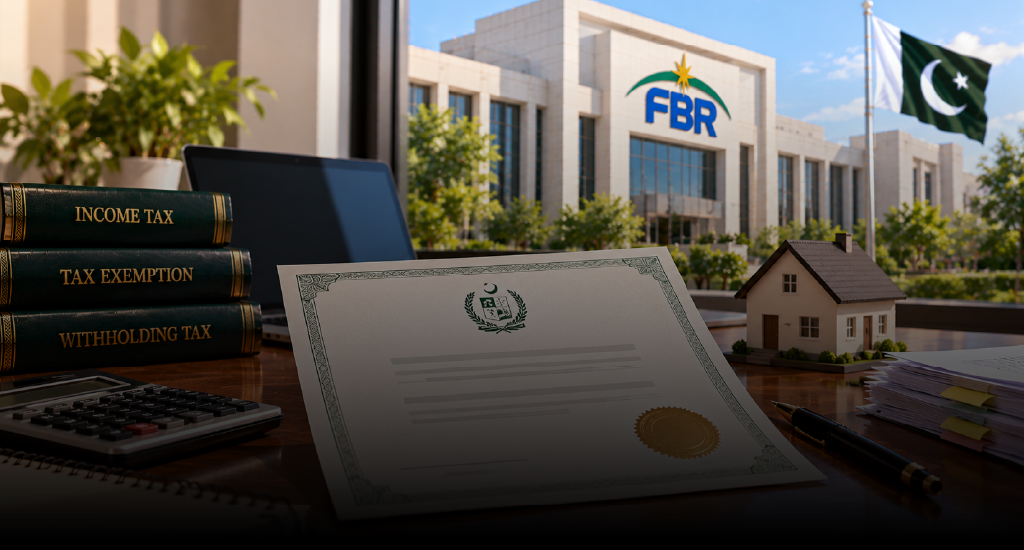
The Federal Board of Revenue (FBR) has outlined the rules for obtaining an income tax exemption or lower-rate certificate in Pakistan for Tax Year 2027 under Section 159 of the Income Tax Ordinance, 2001.
This certificate allows eligible taxpayers to avoid unnecessary tax deductions or benefit from a reduced withholding tax rate where permitted by law. Understanding the eligibility criteria and application process can help individuals and businesses manage their tax obligations more effectively.
What Is an Income Tax Exemption Certificate?
An income tax exemption certificate is an official document issued by the Commissioner Inland Revenue that allows an eligible taxpayer to receive certain payments without tax deduction or at a lower rate.
Under Section 159, a certificate may be issued where:
- The relevant income or payment is exempt from tax.
- The applicable tax rate is lower than the standard rate.
- The income or payment qualifies for a 100% tax credit under the law.
The certificate applies to the relevant payments and transactions covered by its terms.
Who Can Apply for an Exemption Certificate?
Individuals, companies, and other eligible taxpayers may apply if they meet the requirements prescribed under the Income Tax Ordinance, 2001.
Special provisions also cover certain categories, including:
- Companies: Eligible companies can apply for an exemption or lower-rate certificate under Section 159.
- Profit on debt: Individuals whose income is not likely to be taxable may qualify for an exemption certificate on eligible profit-on-debt payments.
- Residential property sellers: Eligible individuals may seek exemption from advance tax on the sale or transfer of qualifying residential property.
- Investment funds and other qualifying entities: Certain entities may qualify by meeting prescribed income-distribution requirements.
- Approved not-for-profit organisations: Organisations with the required approval under the law may qualify for a certificate for the relevant tax year.
Eligibility depends on the applicable legal provisions and the taxpayer’s circumstances.
FBR’s 15-Day Deadline for Companies
Section 159 provides a specific timeline for companies applying for an exemption or lower-rate certificate.
The Commissioner Inland Revenue is required to issue the certificate within 15 days of the company’s application. If it is not issued within this period, the law provides for deemed issuance and automatic processing through the FBR’s Iris system.
However, an automatically issued certificate may subsequently be modified or cancelled by the Commissioner for recorded reasons after providing the company an opportunity to be heard.
Exemption on the Sale of Residential Property
Certain individuals may qualify for exemption from advance tax under Section 236C when selling or transferring residential immovable property.
The prescribed conditions include:
- The property must have been used personally as a residence for the preceding 15 years.
- The property must have been declared in the individual’s wealth statements for the preceding 15 years.
- The property must be recorded as a personal residence in the individual’s tax records.
The certificate under this provision may be issued only once in 15 years, subject to the applicable requirements.
Why Is an Exemption Certificate Important?
Without a valid exemption or lower-rate certificate, the person responsible for deducting or collecting tax generally remains required to apply the relevant statutory tax provisions.
Obtaining the appropriate certificate can help eligible taxpayers:
- Avoid unnecessary withholding tax deductions.
- Apply the correct tax rate to eligible payments.
- Improve cash flow management.
- Maintain accurate tax records.
- Strengthen tax compliance and documentation.
Taxpayers should confirm their eligibility and ensure that the certificate covers the relevant payment or transaction before relying on an exemption.
How Xact Legal Can Help
Xact Legal provides professional tax and legal advisory services in Pakistan to help individuals and businesses understand tax regulations, assess eligibility for exemptions, and navigate withholding tax compliance.
Contact Xact Legal for guidance on income tax exemption certificates, reduced withholding tax rates, and related tax matters.